Cancel a common factor rather than an added term
The same letter is not always a common factor.
Cancellation divides the entire numerator and denominator by a common nonzero factor. In x+1, x is an added term; in x(x+1), it multiplies the whole bracket. Matching symbols alone do not authorise cancellation.
What to do
- Bracket the complete numerator and denominator and identify values making the denominator zero.
- Rewrite both parts as products and cancel only common nonzero factors, retaining original restrictions.
- Check with an allowed substitution, remembering that one example does not prove the general rule.
Example
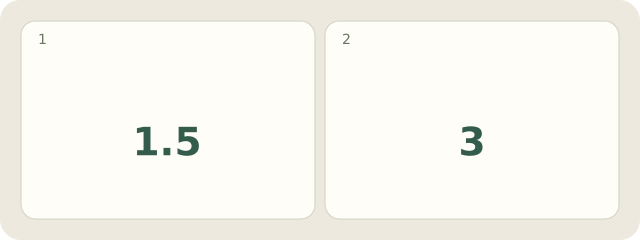
Fictional real-number exercise, x≠0: (x+1)/x=1+1/x, whereas x(x+1)/x=x+1. At x=2, the first fraction is 3/2=1.5 and the second 3. Crossing out x inside the sum to get 1+1 is invalid. The restriction x≠0 remains after cancellation.
My Day · Windows
My Day can store the original expressions and error explanation. You check the algebra yourself.