Distinguish a list alias from a separate flat copy
Check whether names refer to the same list before expecting changes to stay independent.
Assigning a Python list to another name does not itself copy its data. Both names can refer to one mutable object. The copy method makes a shallow copy. This trace uses flat integer lists only; it does not establish full independence for nested objects.
What to do
- Start the first case with a fresh list and mark the object each name refers to.
- After append, record both names’ contents without treating two names as two objects.
- Restart independently for the copy case and compare its two resulting lists.
Example
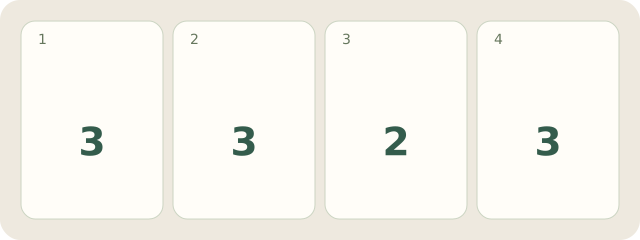
Fictional independent cases: a=[1,2]; b=a; b.append(3) gives a=[1,2,3], b=[1,2,3]. Start fresh: a=[1,2]; b=a.copy(); b.append(3) gives a=[1,2], b=[1,2,3]. Final lengths are 3,3 and 2,3. The second case does not continue the first.
My Day · Windows
In My Day, manually save the check and your next action; verify the source yourself.