Why the square root of a square is absolute value
The radical denotes one nonnegative value.
For real x, √(x²)=|x|. Squaring hides the original sign, while the principal square root selects a nonnegative value. Cancelling both operations to obtain x without checking its sign is therefore invalid.
What to do
- State that the variable is real and separately identify the original value's sign.
- Calculate the square first, then its nonnegative square root; compare that result with the original absolute value.
- Distinguish an expression's value from an equation's solutions, checking positive and negative substitutions.
Example
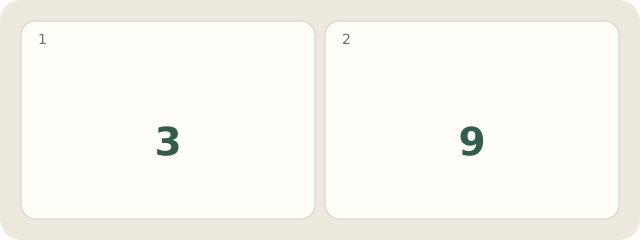
Fictional exercise: at x=−3, the square is 9, √9=3 and |x|=3 although x is negative. At x=3 the result is also 3. Separately, y²=9 has two real solutions, −3 and 3, whereas √9 denotes one number, 3.
My Day · Windows
My Day can store the calculations and distinction between the notations. You check the algebra yourself.