Keep the base case and general induction step
A few matching numerical cases cannot replace the arbitrary-step proof.
This proof for positive integers needs a checked base and a step from arbitrary k to k+1. Initial examples cannot replace that general implication. The assumption for k belongs inside the conditional step, not an already established conclusion for every n.
What to do
- State the claim and positive-integer domain, explicitly choosing n=1 as the starting case for this proof.
- Check the base separately, then assume the claim for arbitrary integer k≥1 rather than one convenient number.
- Add the next term, justify the transformation and connect the general implication to the checked base.
Example
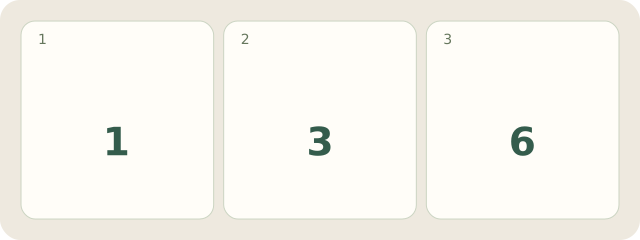
A fictional learner records 1+…+n=n(n+1)/2, n≥1. Base: 1=1·2/2. Assuming 1+…+k=k(k+1)/2 gives k(k+1)/2+(k+1)=(k+1)(k+2)/2. Both proof parts are present. Checks at n=1,2,3 give sums 1,3,6; those cases alone cannot replace the step for arbitrary k.
My Day · Windows
In My Day, save and reopen the comparison as a text note; check the content yourself.