Build a small habit: choose the cue, the minimum and the next review
A small habit is a repeatable action with a clear place in everyday life. It is not a promise that a tiny effort will automatically create a large result. Choose something useful enough to matter and small enough to practise under ordinary conditions. Then observe the action and adjust the design instead of judging yourself by a streak.
Connect the action to a clear cue
Describe the situation in which you will act. “Read more” leaves the decision open all day; “after I put away lunch, open the book and read one paragraph” gives you a recognisable opportunity. A cue can be an existing event or a specific time with suitable surroundings. Check that the action is possible there. A reminder at a moment when the required materials are elsewhere is mainly a reminder of an unresolved obstacle.
Choose a minimum that still has meaning
The minimum should be a real action, not an empty mark. Reading one paragraph, sorting one project note or attempting one vocabulary question can count. Keep any larger optional version separate. If you always turn the minimum into an exhausting session, it stops being a trustworthy minimum. Increase the scope only when you have evidence that the current version fits, and allow the smaller version to remain available.
Select useful everyday examples
A pupil could put tomorrow's workbook into the bag after finishing homework. A student could write one recall question after a lecture. Someone running a small business could record the next action after a client conversation. These actions solve different problems; there is no universally best list of habits. Start with the friction you repeatedly notice in your own day and choose one behaviour that addresses it without requiring a complete life redesign.
Treat a thirty-day challenge as observation
Thirty days can provide a convenient calendar for an experiment, but it cannot guarantee a habit. Before starting, write the action, cue, normal version, reduced version and review date. Record opportunities and actual attempts, including days when the cue did not occur. After a week, change one difficulty you can identify. Do not keep an ineffective design unchanged merely to preserve the appearance of following a challenge.
Adjust after misses and changes
A missed repetition gives you a question to investigate, not a reason to double tomorrow's workload. Was the action too large, the cue unreliable or the environment different? Keep useful evidence and try a smaller repair. Habit formation varies between people and behaviours; neither twenty-one nor thirty days is a universal deadline. For complex outcomes, the habit is only one part of the work: a daily study action still needs suitable material and feedback.
Helpful and unhelpful habits for children, teenagers and adults
A habit is an action often repeated in a familiar situation. Its usefulness depends on consequences and context: checking messages at a chosen time can help, while opening every alert during a lesson interrupts learning. A fourth-grade child can discuss the table with an adult, recognise one example and choose a replacement without being labelled a “bad child”. Handwashing at relevant times, varied food, rest and suitable activity are everyday health practices; this list is not treatment or an individual health programme.
| Situation | Unhelpful repetition | Helpful replacement |
|---|---|---|
| Child before eating | Forgets to wash hands | Use a clear cue and wash with soap |
| Child after playing | Leaves objects in the walkway | Put away one category with an adult |
| Teenager studying | Opens every notification | Agree on a time to check messages |
| Teenager before bed | Keeps scrolling without an endpoint | Choose a stopping point and a calm activity |
| Adult working | Works without planned pauses | Reserve suitable breaks in the plan |
| Any age | Starts without necessary materials | Prepare what the first step needs |
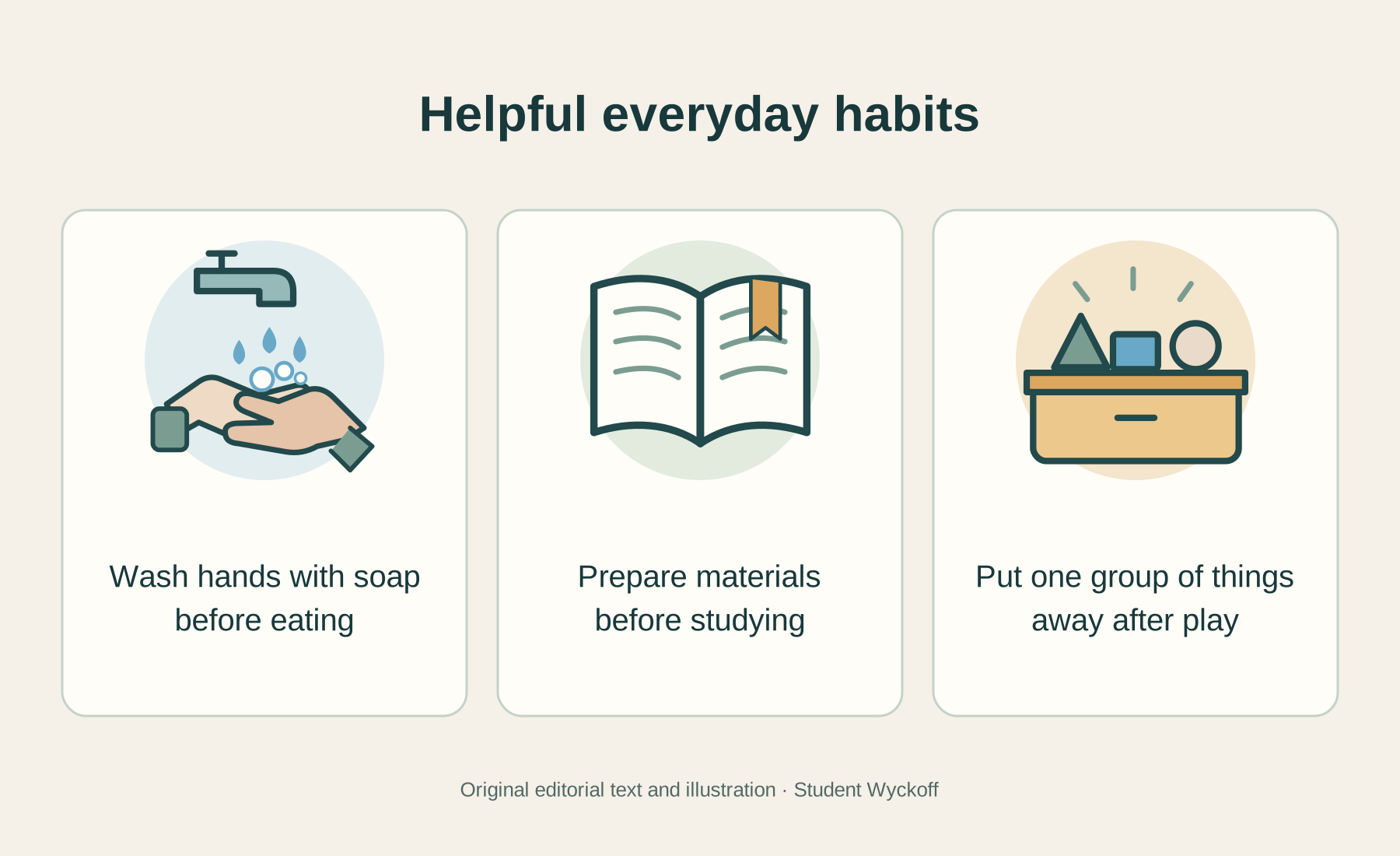
Download the worksheet · Helpful habits: three illustrated actions (SVG)
Habit formation: psychology and small steps
Repeating an action in a stable setting can make it more familiar. Choose a noticeable cue, a manageable response and a way to record what happened. Children need adult demonstration, a clear reminder and gradually reduced assistance. Do not increase several demands at once. There is no universal “every habit in 21 days” law: formation studies show differences between people and actions. One experiment’s timescale cannot be applied to every habit or to breaking habits.
A small step does not guarantee a large success. It helps when repeated, connected to a useful outcome and reviewed. Reading one page provides an entry point; once a week check whether you can explain the meaning and whether to expand. This turns “small steps, big results” into a plan you can examine.
Habit stacking: attach one action to a reliable event
Habit stacking means linking a new action to an existing routine. James Clear describes this cue-based approach and credits BJ Fogg’s Tiny Habits method. Write your version as: “After [a specific existing action], I will [one small new action].” Keep the cue and the action in the same workable setting. Do not attach a daily task to something that happens only on Mondays.
Examples: after putting away lunch, open the marked book; after a lesson, write one recall question; after putting on walking shoes, check the planned route; after closing a work call, record one next action. For an exercise example, prepare for an activity already appropriate for you rather than prescribe extra repetitions. For language learning, after opening your workbook, answer one previously studied question aloud. Review whether you attempted the action, not whether you felt perfectly motivated.
In habit research, automaticity means an action becomes easier to trigger in its familiar context; it is not the same as a checked box. Lally and colleagues followed daily behaviour and self-reported automaticity for twelve weeks; individual modelling varied. This observational design does not guarantee a deadline for your habit or establish the time needed to break one. Use our worksheet to observe a cue and response, without converting a study estimate into a personal promise.
The following are original editorial lines, not quotations from famous people.
“Changing a habit begins with noticing the cue and trying another response.”
“A small step is useful when it serves a real task.”
“One missed attempt can change my plan without cancelling my purpose.”
| Existing event | New small action | Preparation | Review |
|---|---|---|---|
| Put away lunch | Read one paragraph | Book already marked | Review after one week |
| My event | My action | What I need | Review date |
Download the worksheet · Helpful habits: three illustrated actions (SVG)
Breaking Bad Habits NM: a real community action resource
Breaking Bad Habits NM is New Mexico’s official anti-litter campaign. Its own site offers routes to clean-up events, volunteer organisations and reporting litter or illegal dumping. The NM suffix identifies that state context; this is not a general psychology book or an instruction to replace professional help for a harmful behaviour. Use the official local resource for the current event and participation arrangements.
A small environmental action can be a concrete personal-development project. Our own example is to choose a suitable public clean-up, confirm its organiser, time and permitted activity, and record what you actually contributed. Ask the organiser about equipment and safety; do not handle unknown hazardous material or invent collected-weight totals. A My Day note can hold the public event link and your own next action. We have not signed a pledge, registered anyone or sent a report.
| Step | Evidence to keep |
|---|---|
| Choose | Official event/organisation link |
| Confirm | Actual date, organiser instructions and agreed role |
| Participate | What I genuinely did; no invented quantities |
| Review | What I learned and whether another action is useful |
Questions and answers
Can I build several habits at once?
You can, but the total load matters. Beginning with one action makes it easier to identify what helped or hindered. Add another only when you can support both.
What should I do if I miss a day?
Return at the next suitable opportunity and note the cause if it is useful. Avoid treating the missed mark as a debt that requires an oversized session.
Run the experiment in My Day
Use habits to record the selected behaviour and notes to preserve the cue and minimum. Put a necessary action into the daily plan when it needs protected time. Review what you actually did rather than using the number of marks as the whole result.
- Choose one useful action and one reliable cue.
- Record normal and reduced versions.
- Set a review date and save one change to test.
Explore My Day for Windows ↗ · Full instructions for this action ↗