Goal-setting theory and SMART examples: turn a target into a workable plan
A precise sentence can still describe an impossible or unhelpful goal. Decide what the result means, which conditions make it feasible and what evidence you will inspect. Then use a wording checklist and an action plan. The examples below are original teaching scenarios, not measured outcomes or promises about readers.
Theory explains a relationship; SMART checks wording
Locke and Latham’s goal-setting theory concerns how goals relate to task performance. SMART checks whether a chosen goal is specific, measurable, achievable, relevant and time-bound. These are different tools. Filling five boxes does not establish that a task is valuable or that resources exist.
Start with an ordinary question: what will become possible if this result exists? “Write five pages” may be a useful production target, but if the assignment needs a reasoned comparison, page count alone is the wrong completion test. State the reader, required result and limits before choosing the number.
Check challenge, knowledge and feedback
Research conditions include commitment, ability and feedback. Learning-goal research also distinguishes discovering a method from demanding a higher output. An unfamiliar task may first need an experiment or worked explanation.
In our example, a learner cannot yet use a spreadsheet formula. Instead of promising a polished report immediately, they compare two approaches on practice data, explain the formula and then try the report. Before accepting any target, check materials, available time, a source of feedback and conflicting commitments. Increasing a target does not create a missing skill.
Worked SMART examples for different roles
Each fictional example names an output, check and review point. Achievability comes from checking the stated resources with the person; relevance comes from the actual task. Replace the example dates and quantities rather than copying them as a required workload. A teacher or employer may have additional criteria.
| Role | Example goal | Feasibility and quality check |
|---|---|---|
| College student | By Friday, produce a one-page comparison of two assigned sources and explain one disagreement. | Sources are available; a tutor’s criteria and one peer review guide the check. |
| School student | By Friday, solve five percentage problems independently and correct the reasoning. | Three available sessions and a worked model; understanding is checked, not videos watched. |
| Employee | Within two weeks, prepare one reusable instruction and test it on one agreed work case. | The manager confirms scope; a colleague reports unclear steps. |
| Teacher | Before next week’s lesson, rewrite three task instructions and check whether a colleague can explain the expected outputs. | Existing lesson material and an agreed review slot; pupil results are not guaranteed. |
| Early-years educator | By the next planning meeting, write one activity outline with a start, action and finish, then discuss its clarity with a colleague. | Use the setting’s requirements and available materials; this is the educator’s planning goal. |
| Small business team | Over four weeks, test two service descriptions in five agreed customer conversations and record actual objections. | Permission and time are agreed; conversations are evidence, not assumed sales. |
| Personal life | This week, agree one shared evening with the people involved and review whether the arrangement worked on Sunday. | Check everyone’s availability; another person’s agreement cannot be commanded. |
Connect the goal with dated actions and dependencies
An action plan names the result, stages, responsibility, timing and check. It is more specific than a wish list. For the college comparison goal, the writer owns the work; a peer reviews only if they agree. A later stage depends on a usable earlier output. Keep the goal visible while scheduling only the next available action.
| Stage | Next action | Owner / dependency | Review point | Done evidence |
|---|---|---|---|---|
| Question | Read the assignment and choose the comparison question | Writer; assignment available | Monday | Question and criteria written |
| Material | Read the two assigned sources and note locations | Writer; question clear | Tuesday | Two source notes with locations |
| Draft | Write the comparison and one disagreement | Writer; source notes ready | Wednesday | One-page original draft |
| Feedback | Ask the agreed reviewer one specific question | Writer and consenting peer; draft ready | Thursday | Comment and revision decision |
| Delivery | Check references, file and submission | Writer; revisions complete | Friday | Readable file and submission confirmation |
| My plan |
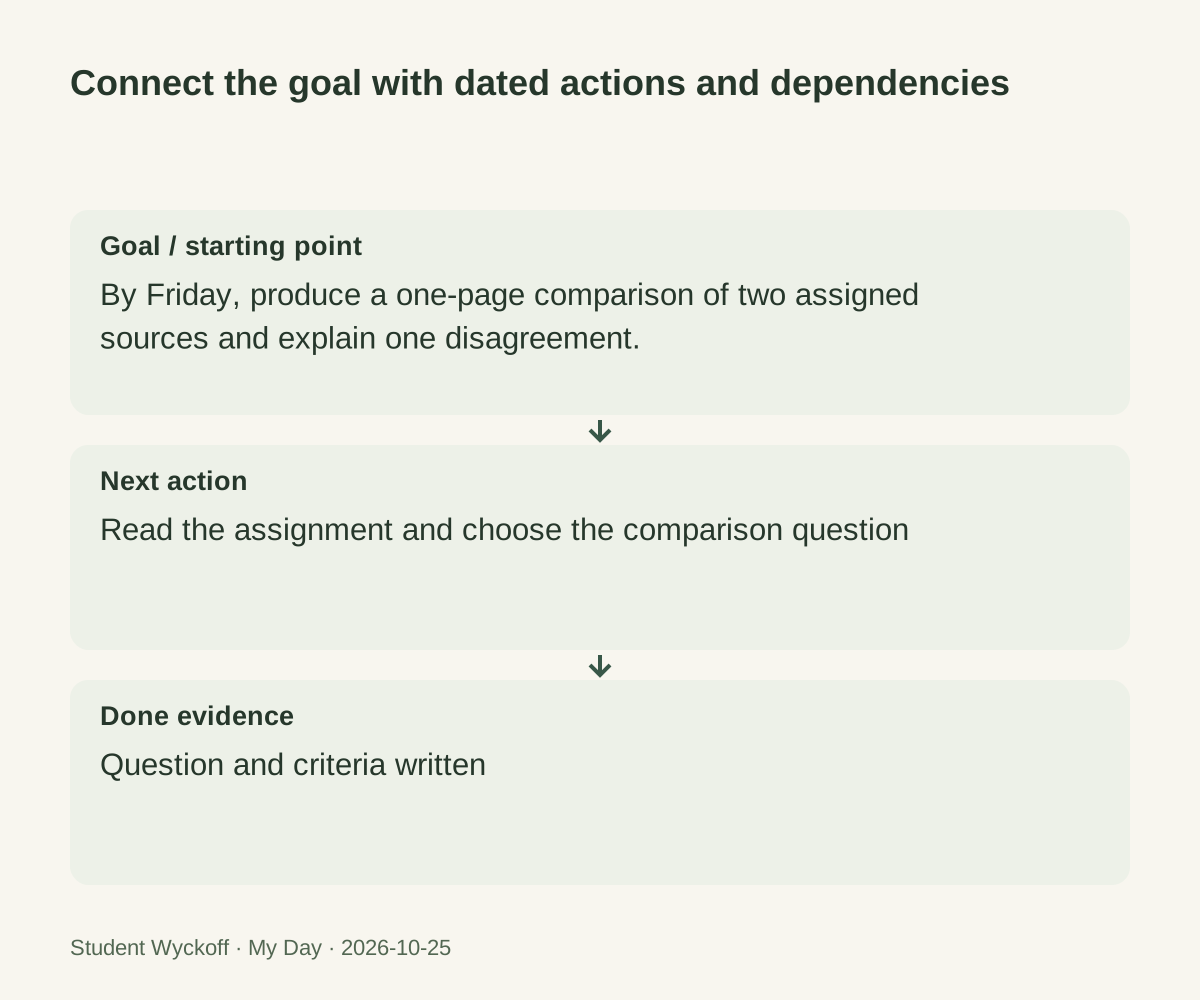
Download the worksheet · Connect the goal with dated actions and dependencies (SVG)
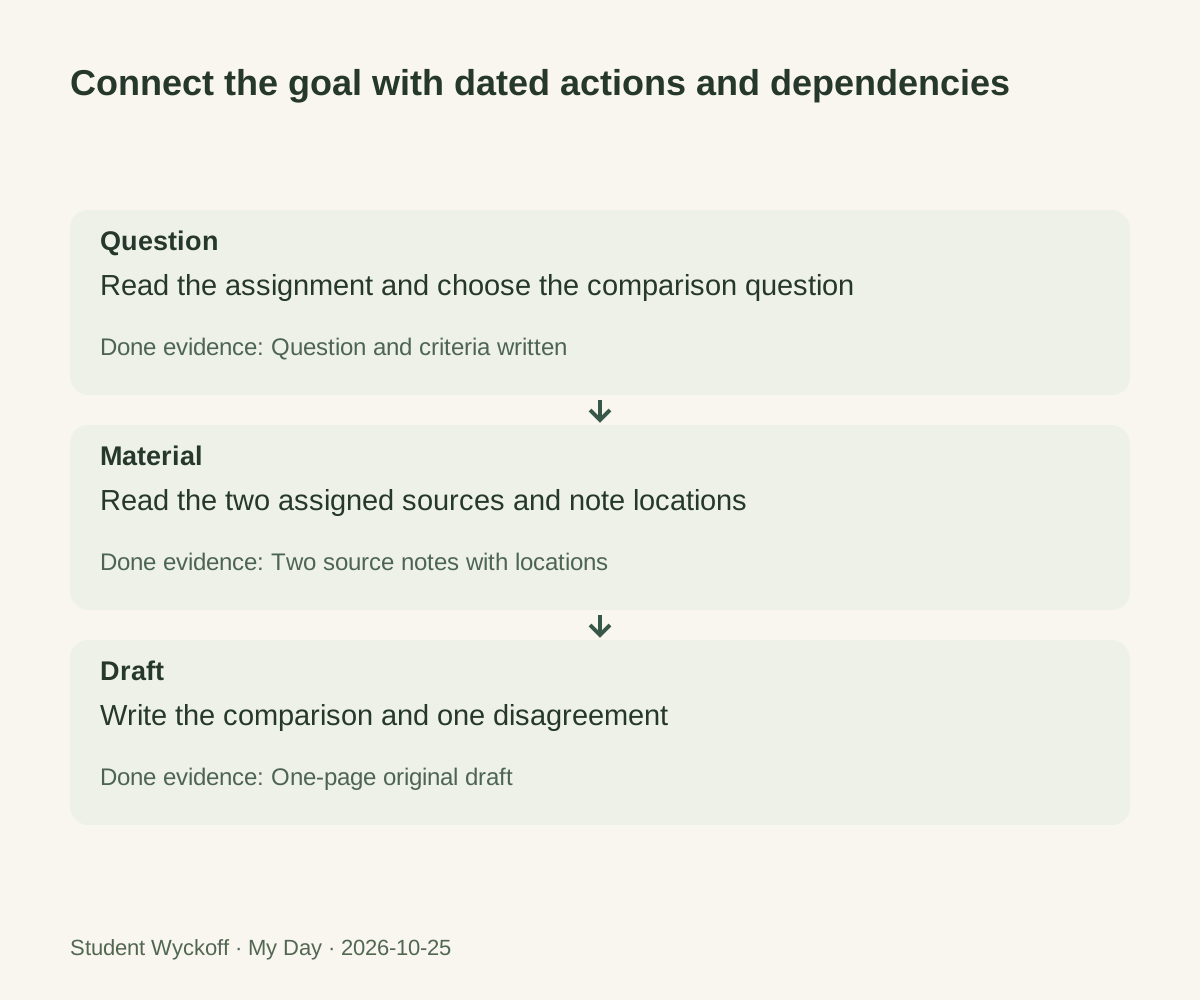
Download the worksheet · Connect the goal with dated actions and dependencies (SVG)
Track progress with evidence rather than a decorative percentage
Record the starting point, intended check, current evidence and next decision. Two correct answers out of five selected questions equal 40% of that small set; they do not prove 40% mastery of a subject. A draft can exist while references remain unchecked. Choose a measure that matches the goal and keep a link to the work.
| Goal / starting point | Check | Observed evidence | Decision / next check |
|---|---|---|---|
| Five problems; no independent attempt yet | Reasoning checked on the selected set | Two independent solutions correct; three need work | Practise the repeated error; retry on Friday |
| Source comparison; two sources selected | One-page argument and checked references | Draft exists; one reference still unclear | Verify the reference before submission |
| My goal |
Use a work review to agree the next goal
At an annual or other performance review, bring actual work, feedback and constraints. Separate what happened from what you propose next. Ask the manager to agree the output, quality criterion, resources, owner and review date. “Be more productive” gives neither person a usable check.
For example, agree to produce a tested instruction for one recurring process next quarter, with a first draft after two weeks and a colleague’s check. The review can change the scope if another priority takes the same time. This is a planning example, not a compulsory HR form or a promise of promotion.
A goal-setting worksheet for an adult, student or supported child
Complete the fields in your own words: what matters now; what I want to make or do; what will show it is ready; what I can already do; what help or materials I need; my first action; when I will check; what I will reduce if it does not fit.
For a younger child, an adult can ask “What would you like to try? What will you show me? What help do you need?” Let the child choose a manageable action and describe the result. A teenager can use the same evidence-based fields without turning the worksheet into a personality score. After trying the first action, revise the plan using the work you can actually show.
SMART in CBSE Class X AI: use the textbook’s wording
For CBSE Class X Artificial Intelligence 417, the 2026–2027 curriculum includes Self-Management Skills-II within Employability Skills. The CBSE-hosted NCERT Class X textbook, first published in 2020, explains SMART as Specific, Measurable, Achievable, Realistic and Time-bound. Here R means Realistic; follow the terminology in your assigned textbook. This is not a claim that every country’s Class 10 follows CBSE.
Our original AI-study goal is: by Friday, explain five terms from the teacher’s assigned model-evaluation lesson in your own words, check them against the lesson criteria and correct uncertain explanations. The current AI curriculum includes evaluating models; the chosen five terms and Friday deadline are our practice example, not official assessment requirements.
| Check | What it means here | Our example |
|---|---|---|
| S: Specific | Name the actual learning output. | Explain the assigned terms in your own words. |
| M: Measurable | Use observable evidence. | Five explanations, each checked. |
| A: Achievable | Split the work and arrange resources. | Use the assigned lesson and a feedback opportunity. |
| R: Realistic | Match the task to available conditions. | One lesson-sized topic, not the whole syllabus overnight. |
| T: Time-bound | Set a review date. | Friday; record what still needs work. |
Questions and answers
Does goal-setting theory mean that the hardest goal is always best?
No. Consider knowledge, resources, commitment, feedback and competing work. An unfamiliar task may need a learning goal before a demanding output target.
Can I call every checked task progress?
A checked action is evidence that the action happened. Progress toward the goal still depends on the output and its agreed criterion.
Keep the goal, next action and evidence in My Day
In My Day for Windows, keep the result and check in a project or note, put the available action on its date and save the resulting work. You judge the evidence and update the plan; the application does not certify SMART wording or professional competence.
- Record one result and its check.
- Create the first dated action.
- At review, attach evidence and choose the next decision.
Explore My Day for Windows ↗ · Full instructions for this action ↗