Use a habit tracker to learn: a weekly table and a replacement plan
A habit tracker is useful when its marks answer a question. Did the opportunity occur? Did you perform the chosen action? What repeatedly got in the way? Define the measure before drawing a monthly grid. The examples below concern everyday study and planning behaviours, not medical monitoring or treatment of dependence.
Decide exactly what a mark means
Choose one observable action and one consistent rule. “Study well” is too broad; “attempt one practice question before checking the answer” is clearer. Use different labels for completed, missed and not scheduled if your review needs that distinction. Do not quietly change the rule halfway through the month. If you alter the habit, note the date and new definition so the two periods remain understandable.
A weekly tracker you can actually fill in
Start with a short table rather than dozens of rows. Copy the example into your own notes or use its cells as a worksheet. The final column should explain an obstacle or next adjustment, not defend your worth as a person. A child can use simpler wording and discuss the result with an adult; avoid public rankings or punishments tied to every empty cell.
| Action and cue | Mon | Tue | Wed | Thu | Fri | Sat | Sun | Observation |
|---|---|---|---|---|---|---|---|---|
| After lunch: read one paragraph | ||||||||
| After class: write one recall question | ||||||||
| At work's end: note the next project action |
Plan a replacement for an unhelpful pattern
For an everyday pattern such as opening social media before starting homework, record the situation and an available alternative. A vague instruction to stop does not tell you what to do in that moment. Make the alternative easy to reach and test whether it serves the need you noticed. The worksheet is a planning aid; it does not diagnose the cause of persistent behaviour.
| Situation | Old response | Replacement | Preparation |
|---|---|---|---|
| Sit down for homework | Open the social feed | Open the marked exercise first | Leave the workbook ready |
| Finish a work call | Forget the next action | Write one action and deadline | Keep the project note open |
Review patterns rather than just totals
At the end of the week, read the observations before counting marks. If several misses happened on late-travel days, try a different cue or a smaller action on those days. If the action happened but did not help, revise the action itself. A streak can describe repeated entries, but it cannot tell you whether a task was correct, a skill improved or the routine remains worthwhile.
Avoid common tracker mistakes
Too many habits create recording work that competes with the actions themselves. Vague definitions make every mark arguable. Backfilling from memory without noting uncertainty creates false precision. Keep the table short, leave genuinely unknown cells uncertain and change one design choice at a time. If tracking makes you increasingly punitive toward yourself, simplify or stop the experiment and seek suitable support where needed.
A monthly habit tracker
Choose one habit and add the month you are tracking. Use rows 1–31 to record the action actually taken and a brief reason for a missed session. Leave dates that do not exist in your month unused. This is an observation sheet, not a promise that a habit forms within a month. Download the CSV and fill it with your own records.
| Month | Day of month | Planned action | Action completed | Observation |
|---|---|---|---|---|
| 1 | ||||
| 2 | ||||
| 3 | ||||
| 4 | ||||
| 5 | ||||
| 6 | ||||
| 7 | ||||
| 8 | ||||
| 9 | ||||
| 10 | ||||
| 11 | ||||
| 12 | ||||
| 13 | ||||
| 14 | ||||
| 15 | ||||
| 16 | ||||
| 17 | ||||
| 18 | ||||
| 19 | ||||
| 20 | ||||
| 21 | ||||
| 22 | ||||
| 23 | ||||
| 24 | ||||
| 25 | ||||
| 26 | ||||
| 27 | ||||
| 28 | ||||
| 29 | ||||
| 30 | ||||
| 31 |
Online monthly tracker for one habit
Mark the days when you actually performed the habit. Saving keeps one habit for the selected month in this browser. This small blog tool has no cloud sync or connection to the Windows app’s entries. Download a CSV copy; delete the draft afterwards on a shared computer.
What counts as a bad habit and how to choose a replacement
Here a bad habit means repeated behaviour with an unwanted consequence for you. Not every habit is an addiction. This diary addresses everyday actions; substance use, self-harm and other dangerous conditions need appropriate support rather than a promise of a tracker cure. Begin with an observable action, its cue and a manageable alternative. In brief: notice the situation, remove one obstacle, try the replacement and record the result. A psychological approach examines the conditions around behaviour instead of explaining everything as bad character.
| Person and setting | Unwanted repetition | Replacement to test |
|---|---|---|
| Child after play | Objects remain underfoot | Put away one category with an adult |
| Teenager doing homework | Opens a feed whenever stuck | Write the question and first request help |
| Adult preparing an email | Keeps switching tabs | Keep the document and necessary source open |
| Any age after a miss | Abandons the whole practice | Schedule the next small attempt |
A monthly self-monitoring journal example and an app
The monthly template in this article has 31 rows. A short example for “phone away during the task”: day 1 — done, a separate shelf helped; day 2 — missed, waiting for an important message; day 3 — done, agreed a contact time beforehand. This is a fictional worked example, not statistics. Record an actual attempt and the conditions, not a person’s worth. The monthly section’s CSV can be saved to your computer free of charge and opened in spreadsheet software.
For a Windows habit-tracking application, My Day 0.3.9 supports day or 12-hour-step marks, cumulative goals, levels, stars and badges; a difficult step preserves accumulated progress. Choose one habit, define observable evidence and mark the fact yourself. The official product link is at the end of this article; check conditions and compatibility before purchasing. Existing users can check for ordinary updates in settings and backups. The worksheet and Windows application are different ways to record progress. This describes our own product, not a comparative “best apps” ranking.
After payment confirmation, the My Day download is on your private order page. Install it, submit the computer code there and receive the activation key on that page. App access is paid; the article’s downloadable CSV worksheet is separate and free.
Choosing a suitable habit-tracker app
“Best” depends on device, storage preferences and whether you want game elements. For Windows and habits alongside study, consider our paid My Day. For Android, official Loop offers a free open-source tracker with reminders and charts. Habitica treats habits as a role-playing game. Official links are in the sources. This compares criteria and real options, not an independent tested ranking. Do not assume a Windows edition of Loop or a free My Day licence.
An accountability journal and a thirty-day experiment
An accountability journal compares a specific commitment with what actually happened. Write the promise, evidence, obstacle and next adjustment. If another person is involved, agree what you will share; the diary does not verify the work or contact them for you. A paper journal is immediate and visible; an app can keep entries together, but extra recording is useful only if it helps action.
For a thirty-day challenge, choose one everyday habit, a cue, a minimum and a review date. Days 1–7: observe opportunities and attempts. Days 8–14: change one obstacle. Days 15–21: check whether the action is useful. Days 22–30: choose what to continue. Thirty days is an observation period, not a reset of your health or a guarantee of habit formation. A healthy-habit example is preparing supplies for an activity appropriate to you, not a restrictive diet or medical programme.
| Prompt | Filled example | My version |
|---|---|---|
| My commitment | After lunch, read one paragraph | |
| Evidence | Page saved; one sentence about the idea | |
| What happened | Two attempts; book unavailable on a travel day | |
| Adjustment | Keep an accessible copy for travel | |
| Review | Check again next week |
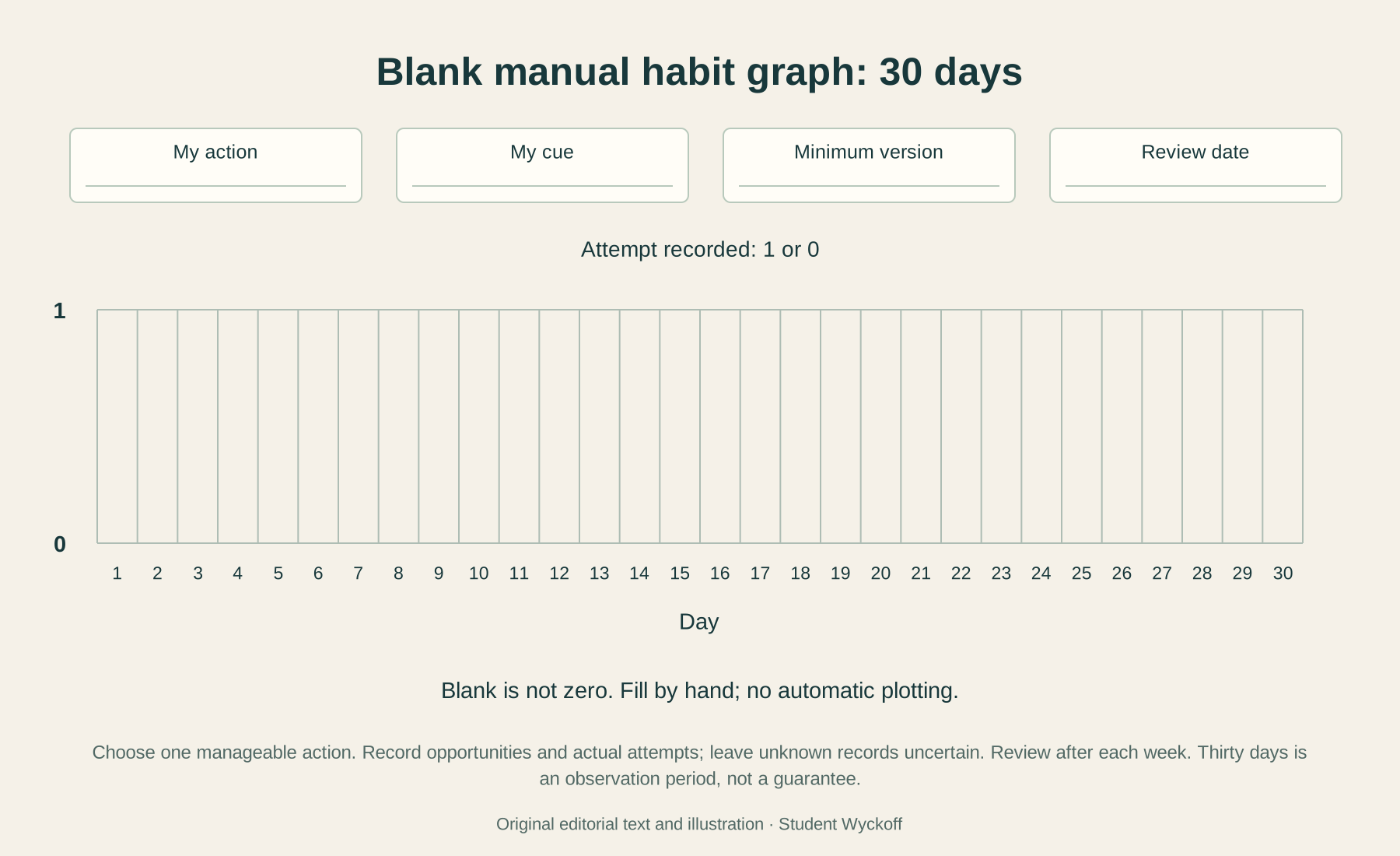
Download the worksheet · Blank manual habit graph: 30 days (SVG)
Questions and answers
Is an empty cell always a failure?
No. It may mean not scheduled, no opportunity or no reliable record. Choose labels that preserve the distinction you need.
Should I restart the whole month after a miss?
Usually a new month is not needed to learn from one miss. Record it honestly and continue with a sensible next opportunity.
Keep the meaning of marks in My Day
My Day offers habits and saved notes. Record the definition of your habit in a note and use the habit record for repetitions. The tables here are editorial worksheets; they are not a claim that the application contains these exact built-in forms.
- Define the mark before recording it.
- Save the cause of a recurring miss.
- Review the action and its usefulness once a week.
Explore My Day for Windows ↗ · Full instructions for this action ↗