Meaningful SMART goals: choose a result before filling a planner
A useful goal helps you decide between competing tasks. It describes a change you want to see, rather than asking you to stay busy. Use a school example, a workplace example and a small review to separate progress from a growing collection of check marks.
Choose a reason before choosing a number
Choose one area in which a change would matter: a subject at school, a professional skill or a personal project. Ask what the change would make possible and what you are willing to give up for it. “Become successful” does not answer either question. A student might value solving a problem independently; an employee might need a usable piece of work. These are different definitions of success. A priority deserves time in your actual week, rather than simply sounding impressive in a list.
A worked SMART example
Use SMART to check whether a goal is specific, measurable, achievable, relevant and time-bound. For example, a student chooses to solve five percentage problems independently by Friday and compare the solutions with a worked answer. Watching five videos would measure a different activity. At work, a useful result could be a draft instruction a colleague can test on one real case by Wednesday. A deadline creates a review point; it does not guarantee that unfamiliar work will fit your first estimate.
| Context | Checkable result | Next action |
|---|---|---|
| Study | Five independent solutions by Friday | Study one worked example and solve a similar problem |
| Work | An instruction draft by Wednesday | Describe one real work case |
Goals and systems do different jobs
A goal describes an outcome; a system describes the repeatable actions supporting it. The percentage goal might need three short practice sessions, an error log and one question for the teacher. Repeating the same unsuccessful exercise is not automatically a good system. Change the explanation or difficulty when necessary. Separate actions you control from results involving other people: submitting a complete application on time is an action, while receiving an offer depends on an employer as well.
- Write one desired result and explain why it matters in the current period.
- Choose evidence: a solved example, a usable draft or a demonstration someone can check.
- Select the next manageable action and a date for reviewing the plan.
Review the goal without gaming the measure
At review time, compare the starting point with a piece of evidence. What can you now do without help? What remains uncertain? If the deadline slipped, distinguish an unrealistic estimate from a missing resource or an external dependency. Reducing the scope while keeping the purpose can be more useful than moving the date repeatedly. Avoid measuring everything merely because a number is available. Friendship, recovery and curiosity need room too; a personal plan does not have to rank every part of life.
Long-term and short-term goals: the difference and examples
A long-term goal describes a meaningful result beyond the current short work cycle: preparing for a chosen direction by the end of school, or becoming more independent professionally over several years. There is no universal number of months; the task determines the horizon. A short-term goal is the next checkable outcome supporting that direction. Horizon and size differ: a small action can support a multi-year intention.
A school student might aim to manage a project independently by the end of an educational stage, starting with a small investigation. A university student might build a portfolio by graduation, beginning with one reviewed piece. In personal life, the aim may be sustainable time for relationships and interests, starting with one agreed week. In an interview, name a real direction, skill and evidence: “I want to take on more independent analysis; I am building a practice example and seeking feedback.” This is an editorial example, not a promise of a particular position.
All five SMART checks and a form to complete
In a discussion about self-regulation, SMART turns an intention into an observable action and an agreed feedback point. It is not a psychological test, diagnosis or explanation of every cause of behaviour. Check whether the person actually values the goal. The complete original example is to solve five percentage problems independently by Friday. Fill in your column; reduce the scope if time or prerequisite knowledge is missing.
| Component | Check question | Completed example | My version |
|---|---|---|---|
| S — specific | What will I do? | Solve percentage problems | |
| M — measurable | How will I check? | Five independent solutions, compared with a model | |
| A — achievable | Which resources are available? | Three sessions, an understandable example and help with a question | |
| R — relevant | Why does it matter? | Handle this type of problem independently | |
| T — time-bound | When will I review? | Friday after the final session |
SMARTER: add evaluation and review
SMARTER has more than one expansion. Here E means evaluated: check actual progress; the final R means reviewed: reconsider the goal and approach. NYU and Manchester Metropolitan university materials describe this version. On Wednesday, a learner checks two independent solutions: one works, the other uses the wrong percentage base. They add practice on that step and retain Friday’s check if time still allows. This is adjustment using evidence, not another promise of success.
Ten life areas, a priority worksheet and original lines
Values describe what matters; a priority decides what receives attention in this period; a goal names an outcome. Ten areas below are a menu, not an ordered duty list. Select two, write why now, and name what receives less time. Respect actual responsibilities and the people whose agreement is involved. Review the choice on a real date.
Use these fields: chosen area, present situation, why it matters, one desired change, time/help available, what I postpone, first action and review date. For example, choose study and family this month, reserve a practice block and an agreed visit, and defer an optional project.
Original editorial lines, not attributed to famous people: “An important goal deserves a real choice in my week.” “A system is what I return to; a goal is what I check.” “Family time and work time need an agreement, not just an empty cell.” “One checked result is more useful than an impressive promise.” “I plan time so that an important action has a place to begin.”
| Area | Question before choosing |
|---|---|
| Study | What do I need or want to understand? |
| Work | Which useful result is my responsibility? |
| Family | What have we actually agreed? |
| Relationships | Which conversation or shared activity matters? |
| Rest | What time will remain free of extra commitments? |
| Everyday care | Which ordinary responsibilities need room? |
| Money organisation | Which record or agreed budget task needs attention? |
| Creativity | Which small piece would I like to make? |
| Community | What contribution can I genuinely commit to? |
| Curiosity | What would I like to explore without a performance quota? |
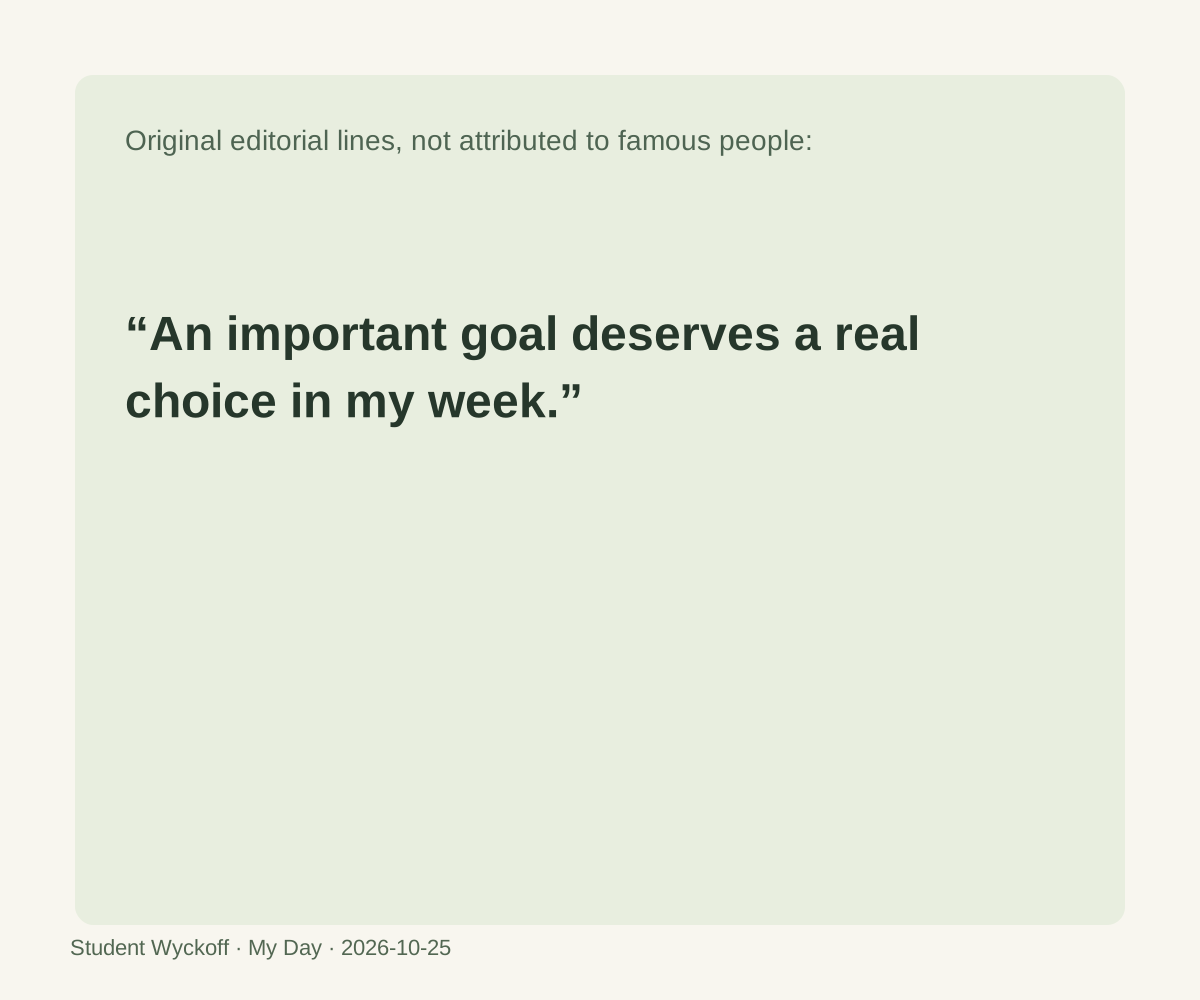
Download the worksheet · Ten life areas, a priority worksheet and original lines (SVG)
Questions and answers
Does SMART guarantee success?
No. It makes expectations easier to discuss and examine. Difficulty, circumstances and the quality of the work still affect the outcome.
What if two goals compete?
Compare their time requirements and consequences. Choose the current priority, then reduce, postpone or deliberately pause the other goal.
Use the plan in My Day
In the Windows application, keep the desired result in a note and place the actual actions in your daily plan or project. You assess the SMART wording yourself; the application does not produce an automatic verdict on goal quality. After a session, save a small piece of work and explain what you will change next.
- Add a task such as “solve and check one example”.
- Use a focus session if it helps you begin.
- Record the difference between the expected and actual result.
Explore My Day for Windows ↗ · Full instructions for this action ↗